
ABOUT R&D ACTIVITIES R&D PROGRAMS PEOPLE PUBLICATIONS
ABOUT
The Computational Neuroscience group (CN group) was formed in 1996 with the aim to employ applied mathematics to understand how the brain works. The brain is a highly complex piece of biological machinery, compartmentalized into several subsystems and made up of hundreds of billions of cells each one of which can perform complex computations on the basis of which it influences several other cells. The mechanisms that underlie neural processes (e.g., vision, learning, emotion, action, cognition) have been the object of intense enquiry for hundreds of years. Computational Neuroscientists strive to provide a description of the mechanisms that underlie such processes in the form of realistic models of the brain. Study of the properties and performance of these models allows one to evaluate the epistemic adequacy of available experimental data and the consistency of theoretical formulations. The CN group places particular emphasis on efforts to understand how the brain generates and controls purposeful movements such as orienting the eyes and the head towards objects, reaching for them with an arm and grasping them with an appropriately configured hand. What are the areas of the brain that participate in these processes and how do they generate the signals that control these actions? How are movement variables represented in the spatial and temporal properties of populations of neurons? How do the laws of physics, the geometry of objects manipulated and their mechanical properties influence command signals? To address questions such as these we collect experimental evidence concerning the movement related engagement of brain regions, the behavioral relevance of the discharge patterns of the neurons they contain, the connections they establish with other neurons and the psychophysics of movements generated when the relevant neural networks are activated or lesioned. Finally, we use computer assisted neuronal modeling to evaluate the epistemic adequacy of the data and the consistency of the models they motivate.
RESEARCH AND DEVELOPMENT ACTIVITIES
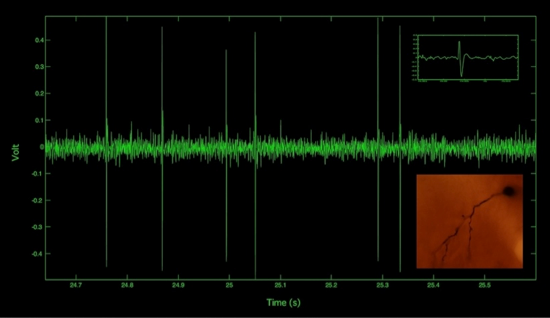
Neurophysiology of movement and action perception: Neural activity (spike trains and local field potentials) is recorded from animals trained to execute eye and arm movements and analyzed to gain insight into the movement variables coded by single neurons or populations of neurons. We aim to a) understand how the discharge pattern of neurons control the line of sight and coordinated eye-hand movements, b) understand the neural basis of a fundamental human behavior, grasping, and object manipulation and c) decipher the neural mechanisms of social cognition
Our current efforts focus on:
- disentangling the role of the dorsal and ventral premotor cortex in the control of hand-grasping actions, assess the intra- and inter-areal dynamics, and examine causal influences in the premotor grasping network.
- revealing how the brain processes observed actions and the mechanisms whereby we assign meaning to others’ actions by investigating the underlying neural dynamics at the micro-, meso-, and macroscopic scales.
- developing decoders for the real-time control of a dexterous hand able to manipulate objects versatilely using neural signals recorded from the forelimb representations of the dorsal and ventral premotor cortical areas.
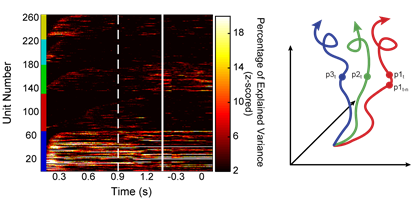
Neurophysiology of visual attention and memory: We record and analyze neural activity patterns at different spatial scales (single neurons, neuronal populations, neural networks, anatomically defined areas, distinct cortical layers) to reveal the neural code of cognitive variables in visual attention and working memory.
Our goals are:
- to clarify how sensory, cognitive and behavioral parameters are represented in distributed patterns of activity across neuronal populations. We employ multi-electrode array recordings, machine-learning algorithms and dimensionality reduction approaches to decode task relevant information from population activity and infer the stationarity, sparsity and population dynamics of the neural code.
- to elucidate the systems and circuit level mechanisms that underlie long-range communication and large-scale integration across distant brain areas. To this end, we use advanced signal processing methods to study the temporal dynamics of long-range interactions between neuronal populations in prefrontal and visual cortex and assess the functional and anatomical specificity of such interactions in order to reveal the circuit mechanisms of visual attention and working memory. Moreover, we infer directional and causal information flow between distinct network nodes using statistical measures of directional influences for continuous signals and point processes.
Brain imaging of observational learning and attribution of agency: The quantitative, autoradiographic 14C-deoxyglucose technique, image analysis, and two-dimensional reconstruction of the local cerebral glucose utilization is used to investigate: 1) cortical cerebral pathways associated with voluntary arm-reaching movements of monkeys executing learned visuo-skeletomotor tasks and the visual or somatosensory guidance of the arm, 2) cortical and subcortical regions, related to saccadic eye-movements in the monkey brain and how they encode parameters of saccades (direction, amplitude, eye-position and trajectory), 3) cortical areas involved in execution of grasping movements either guided by sensory stimuli or memorized and the observation of actions performed by others.
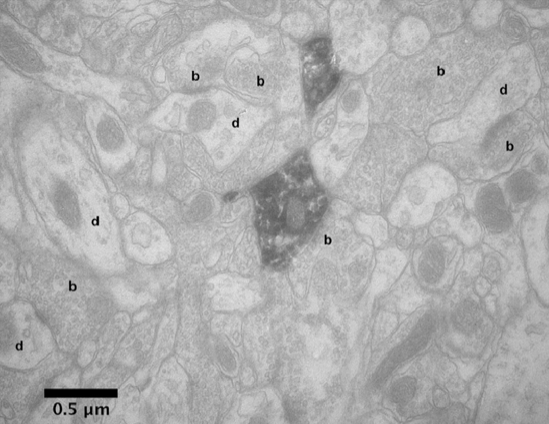
Neuroanatomy of the mesencephalon and the cerebral cortex: Immunohistochemistry, light/electron microscopy and extracellular tracer injections are used to study the synaptic organization of neural systems in the mammalian brain including cortical and subcortical oculomotor areas/nuclei, the neocortex and hippocampus.
Mathematical modelling of decision processes and central pattern generation: Computer simulations consistent with known anatomy, physiology, neurology and psychophysics are developed to understand the neural control of purposeful action. Decoding of behavioural parameters from activity patterns of neuronal populations using machine learning algorithms.
Education and Training: The group contributes to the education and training of undergraduate, graduate and post-graduate students as well as of PhD candidates and Postdoctoral researchers. Further, the group contributes to the Interdisciplinary Graduate Program “BRAIN and MIND sciences“.
RESEARCH AND DEVELOPMENT PROGRAMS
A. ONGOING PROJECTS
- Title: NEUROADAPT: Advancing Personalized Neuromodulation: Integrating NeuroAI into Real-Time Adaptive Brain Stimulation
Funding Agency and funding scheme: FORTH SYNERGY GRANTS
Duration: 09/2005-08/2027
B. COMPLETED PROJECTS
- Title: In2PrimateBrains: Intra- and Inter-Areal Communication in Primate Brain Networks.
Funding Agency and funding scheme: European Union, H2020-MSCA-ITN-2020 (Marie Skłodowska-Curie Innovative Training Networks)
Duration: 03/2021-02/2025 - Title: Micro-and mesoscopic study of neuronal interactions and network dynamics in cognition. The role of distinct prefrontal-temporal circuits in attention and memory.
Funding Agency and funding scheme: Hellenic Foundation for Research and Innovation (H.F.R.I.) under the “First Call for H.F.R.I. Research Projects to support faculty members and researchers and the procurement of high-cost research equipment”.
Duration: 20/08/2020-19/02/2024 - Title: Layer-specific characterization and modeling of fronto-parietal dynamics in primate cortical networks, Project number: Τ11ΕΡΑ4-00014, MIS: 5070462
Funding Agency and funding scheme: General Secretariat for Research and Technology, Greece, “Call for funding of research projects under the national action ERANETs 2019b – European R&Τ Cooperation – Funding of Greek Hosts that participated successfully in Common Calls to submit proposals in the European Networks ERANETs”.
Duration: 06/08/2020-05/08/2023 - Title: Assigning Meaning to the Actions of Other Subjects: Neural Correlates.
Funding Agency and funding scheme: Hellenic Foundation for Research and Innovation (H.F.R.I.) under the “First Call for H.F.R.I. Research Projects to support faculty members and researchers and the procurement of high-cost research equipment”.
Duration: 2019-2023 - Title: Decoding cognitive information from populations of neurons towards the development of a brain-machine interface.
Funding Agency and funding scheme: Hellenic Foundation for Research and Innovation (H.F.R.I.) under the “First Call for H.F.R.I. research projects to support Postdoctoral Researchers”.
Duration: 2019-2023 - Title: Bridging neural activity and perception: correlations and causality between activity of single neurons, neuronal populations, oscillatory dynamics and attentive behavior
Funding Framework: Bodossakis Foundation – Research Grant in Biomedicine
Duration: 2018 – 2019 & 2020-2021 - Title: Neural mechanisms of attention during visual search
Funding Framework: Fondation Sante, Research Grant in Biomedical Sciences
Duration: 2015 – 2017 - Title: Neural Mechanisms of Visual Search
Funding Framework: ΑΡΙΣΤΕΙΑ ΙΙ, Ευρωπαϊκό Κοινωνικό Ταμείο και ΓΓΕΤ
Duration: 2014 – 2016 - Title: Mental Training in Artificial Agents
Funding Framework: ΑΡΙΣΤΕΙΑ ΙΙ, Ευρωπαϊκό Κοινωνικό Ταμείο και ΓΓΕΤ
Duration: 2014 – 2016 - Title: Mental Simulation of Action
Funding Framework: ΑΡΙΣΤΕΙΑ ΙΙ, Ευρωπαϊκό Κοινωνικό Ταμείο και ΓΓΕΤ
Duration: 2014 – 2016 - Title: Neurophysiology and modeling of action observation
Funding Framework: Bilateral S&T Cooperation Program, GSRT
Duration: 2014 – 2015 - Title: Interactions between prefrontal cortex and area V4 in attention
Funding Framework: EU/Marie Curie FP7-PEOPLE-2009-RG
Duration: 2010 – 2013 - Title: The role of parietal and prefrontal cortex in visual selection
Funding Framework: Ενίσχυση Μεταδιδακτόρων, ΓΓΕΤ
Duration: 2010 – 2013 - Title: Attribution of action to the correct agent
Funding Framework: Ενίσχυση Μεταδιδακτόρων, ΓΓΕΤ
Duration: 2010 – 2013
PEOPLE
RESEARCHERS
- Dalezios, Yiannis, Collaborating Faculty Member
- Gregoriou, Georgia, Collaborating Faculty Member
- Moschovakis, Adonis, Professor Emeritus
- Raos, Vassilis, Collaborating Faculty Member
- Sapountzis, Panagiotis, Postdoctoral Researcher
- Savaki, Helen, Professor Emerita
TECHNICAL SCIENTISTS
- Kephaloyianni, Maria, Technical Scientist
STUDENTS
- Aliprantis Stamatios, PhD candidate
- Caytan Emile, PhD candidate
- Paneri Sofia, PhD Candidate
- Sifaki Aikaterini, PhD Candidate
- Theodorou, Irene, PhD candidate
- Tzanou, Athanasia, PhD candidate
PUBLICATIONS
- S Paneri, P Sapountzis, GG Gregoriou (2026) Distinct theta mechanisms mediate target enhancement and distractor suppression in the primate prefrontal—V4 network, bioRxiv, 2026.08. 24.746662
- A Morales-Gregorio, R Gutzen, S Paneri, P Sapountzis, A Kleinjohann, S Grün, A Riehle, X Chen, T Brochier, GG Gregoriou, BE Kilavik, SJ van Albada (2025) Spontaneous spiking statistics form unique area-specific fingerprints and reflect the hierarchy of cerebral cortex, bioRxiv
- P. Sapountzis, A. Antoniadou, G.G. Gregoriou (2025) Diverse neuronal activity patterns contribute to the control of distraction in the prefrontal and parietal cortex, PLOS, https://doi.org/10.1371/journal.pbio.3003008
- Theocharous A., Gregoriou G.G., Sapountzis P., Kontoyiannis I.(2024) Temporally Causal Discovery Tests for Discrete Time Series and Neural Spike Trains, IEEE Transactions on Signal Processing.
- A Theocharous, GG Gregoriou, P Sapountzis, I Kontoyiannis (2024) Causality Testing, Directed Information and Spike Trains, 2024 IEEE International Symposium on Information Theory (ISIT), 274-279.
- F Balci, SB Hamed, T Boraud, S Bouret, T Brochier, C Brun, JY Cohen, E Coutureau, M Deffains, V Doyère, G Gregoriou, J Heimel, B Kilavik, D Lee, E Leuthardt, Z Mainen, M Mathis, I Monosov, J Naudé, A Orsborn, C Padoa-Schioppa, E Procyk, B Sabatini, J Sallet, C Sandi, J Schall, A Soltani, K Svoboda, CWilson, J Zimmermann (2023) A response to claims of emergent intelligence and sentience in a dish, Neuron 111 (5), 604-605
- Theocharous A., Gregoriou G.G., Sapountzis P., Kontoyiannis I. (2023) Temporally Causal Discovery Tests for Discrete Time Series and Neural Spike Trains, arXiv preprint arXiv:2305.14131
- Sapountzis P, Paneri S., Papadopoulos S., Gregoriou G.G. (2022) Dynamic and stable population coding of attentional instructions coexist in the prefrontal cortex Proc Natl Acad Sci U S A. 119 (40) e2202564119
- Kallergi, E., Daskalaki, A.-D., Kolaxi, A., Camus, C., Ioannou, E., Mercaldo, V., Haberkant, P., Stein, F., Sidiropoulou, K., Dalezios, Y., Savitski, M.M., Bagni, C., Choquet, D., Hosy, E., Nikoletopoulou, V. Dendritic autophagy degrades postsynaptic proteins and is required for long-term synaptic depression in mice (2022) Nature Communications, 13 (1), art. no. 680.
- Savaki, H.E., Kavroulakis, E., Papadaki, E., Maris, T.G., Simos, P.G. Action Observation Responses Are Influenced by Movement Kinematics and Target Identity (2022) Cerebral Cortex, 32 (3), pp. 490-503.
- Raos V, Savaki HE. Functional Imaging of the Cerebellum during Action Execution and Observation (2021) Cerebral Cortex Communications 2 (3), tgab041
- Paneri S, Sapountzis P, Gregoriou GG (2021) Spatial attention induces frequency-specific long-range interactions between ventrolateral prefrontal cortex and visual cortex. 44th Annual Meeting of the Japan Neuroscience Society, Kobe Convention Center/Hybrid Format, 28-31 July 2021
- Sapountzis P, Paneri S, Gregoriou GG (2021) Decoding visible and memorized stimulus features from neuronal ensembles in the prefrontal and visual cortices 2021 Vision Sciences Society.
- Tzamali E, Papadourakis V, Raos V. (2021). Visual to motor cross-decoding of hand shapes from mirror neuron activity. Vision Sciences Society 2021.
- Tzamali E, Papadourakis V, Raos V. (2021). Observation to execution cross-decoding of hand grips from ventral premotor cortex spiking activity. Computational and Systems Neuroscience (COSYNE 2021).
- Morales-Gregorio A, Dąbrowska P, Gutzen R, Yegenoglu A, Diaz-Pier S, Palmis S, Paneri S, René A, Sapountzis P, Diesmann M, Grün S, Senk J, Gregoriou GG, Kilavik B, van Albada SJ, (2020) Estimation of the cortical microconnectome from in vivo spiking activity in the macaque monkey. 29th Annual Computational Neuroscience Meeting.
- Paneri S, Sapountzis P, Gregoriou GG (2020) Long-range interactions between ventrolateral prefrontal cortex and visual cortex during spatial attention 12th FENS Forum of Neuroscience, Glasgow, United Kingdom
- Sapountzis P, Paneri S, Gregoriou GG (2020) Parieto-frontal interactions as a mechanism for working memory maintenance 12th FENS Forum of Neuroscience, Glasgow, United Kingdom
- Morales-Gregorio A, Dąbrowska P, Kilavik B, Gregoriou GG, Brochier T, Diesmann M, Grun S, Senk J, van Albada SJ. (2019) Activity-constrained full-scale cortical microcircuit models of macaque higher-order cortices. Bernstein Conference 2019, Berlin, Germany.
- Papadourakis, V., Raos, V. Neurons in the Macaque Dorsal Premotor Cortex Respond to Execution and Observation of Actions (2019) Cerebral Cortex, 29 (10), pp. 4223-4237.
- Sapountzis P, Paneri S, Gregoriou GG. (2019) Encoding and Working Memory Maintenance of Feature and Spatial Information in the Parietal and Prefrontal Cortex ESI Systems Neuroscience Conference 2019, The recurrent cortex: Feedback dynamics and dimensionality, Frankfurt, Germany
- Savaki, H.E., Raos, V. Action perception and motor imagery: Mental practice of action (2019) Progress in Neurobiology, 175, pp. 107-125.
- Savaki HE, Raos V. (2019). Functional imaging of the monkey cerebellar cortex during action execution and observation. Program No. 405.06 2019 Neuroscience Meeting Planner. Chicago: Society for Neuroscience, 2019. Online.
- Savaki, H. A specific immunity brain aging gene with a future (2018) EBioMedicine, 36, p. 9.
- Neromyliotis E., Moschovakis A.K. (2018) Response properties of saccade-related neurons of the post-arcuate premotor cortex. J. Neurophysiol. 119: 2291-2306.
- Sapountzis P., Paneri S., Gregoriou G.G. (2018) Distinct roles of prefrontal and parietal areas in the encoding of attentional priority (In press) Proc. Natl. Acad. Sci. U.S.A.
- Sapountzis, P., Gregoriou G.G. (2018) Neural signatures of attention: insights from decoding population activity patterns. Front. Biosci., Landmark Edition, Invited Review, 23:221-246, doi: 10.2741/4588.
- Neromyliotis E, Moschovakis AK. (2017) Saccades evoked in response to electrical stimulation of the posterior bank of the arcuate sulcus. Exp Brain Res 235: 2797–2809, d
- Neromyliotis E, Moschovakis AK. (2017) Response properties of motor equivalence neurons of the primate premotor cortex. Front Behav Neurosci 11: 1-21,
- Paneri S., Gregoriou G.G. (2017) Top-down control of visual attention by the prefrontal cortex. Functional specialization and long-range interactions. Front. Neurosci, Invited Article, Research topic “Prefrontal cortex and executive functions”, 11:545,
- Papadourakis V, Raos V. (2017) Evidence for the representation of movement kinematics in the discharge of F5 mirror neurons during the observation of transitive and intransitive
actions. J Neurophysiol 118(6): 3215-3229, - Raos V, Savaki HE. (2017) The role of the prefrontal cortex in action perception.
Cereb Cortex 27(10): 4677-4690. - Papadourakis V, Raos V. 2017. Properties of mirror neurons in the dorsal premotor cortex of the
macaque brain. Comparison with F5 mirror neurons. Program No. 497.12 2017 Neuroscience Meeting Planner. Washington, DC: Society for Neuroscience, 2017. Online. - Ashena N, Papadourakis V, Raos V, Oztop E. 2017. Real-Time Decoding of Arm Kinematics During Grasping Based on F5 Neural Spike Data. Advances in Neural Networks – International Symposium on Neural Networks 2017, Proceedings Part I, 261-268.
- Raos V, Savaki HE. (2016) Perception of actions performed by external agents presupposes knowledge about the relationship between action and effect. Neuroimage. 132: 261-273,
- Gregoriou G.G., Paneri S., Sapountzis P. (2015) Oscillatory synchrony as a mechanism of attentional selection. Brain Res Special Issue on Attention and Prediction. 1626:165-82,
- Kirtay M, Papadourakis V, Raos V, Oztop E. (2015) Neural representation in F5: cross-decoding from observation to execution. BMC Neuroscience, 16 (Suppl 1):P190.
- Papadourakis V, Raos V. Mirror neurons respond to the observation of intransitive actions. Program
No. 601.15 Neuroscience Meeting Planner. Washington, DC: Society for Neuroscience, 2015. - Savaki H.E., Gregoriou G.G., Bakola S., Moschovakis A.K (2015) Topography of visuomotor parameters in the frontal and premotor eye fields. Cerebral Cortex 25(9):3095-106.
- Kilintari, M., Raos, V., Savaki, H.E., (2014). Involvement of the superior temporal cortex in action execution and action observation. J Neurosci. 34(27): 8999-9011.
- Papadourakis, V., Raos, V., (2014). Action observation elicited responses in the dorsal premotor cortex (area F2) of the macaque monkey. 9th FENS Forum of Neuroscience. Abstract Number: FENS2021
- Raos, V., Kilintari, M., Savaki, H.E., (2014). Viewing a forelimb induces widespread cortical activations. Neuroimage 89: 122-142.
- Sapountzis, P., Gotts, S.J., Desimone, R., Gregoriou, G.G., (2014). Cell-class specific attentional modulation of neuronal responses and synchronization in the frontal eye field and area V4. Society for Neuroscience (SfN) Annual Meeting, 156.13/DD28, Washington DC.
- Sapountzis, P., Anastasakis, S., Desimone, R.,
- Gregoriou, G.G., (2014). Decoding covert attention from simultaneous recordings in prefrontal and visual cortex. AREADNE, Research in Encoding and Decoding of Neural Ensembles, Santorini, Greece.